

Construction Contracts in Australia: Risk Allocation and Security of Payment
Summary
Construction contracts allocate risk through a web of interconnected provisions - extensions of time, liquidated damages, variations and latent conditions. When these provisions are poorly drafted, disputes follow. This article explains the key risk allocation mechanisms and the security of payment protections that apply regardless of what the contract says.
Key Takeaways
- Construction contracts allocate risk through interconnected provisions including extensions of time, liquidated damages, variations and latent conditions, and poorly drafted provisions in any one area can produce unexpected consequences across the entire risk framework.
- Liquidated damages clauses must represent a genuine pre-estimate of loss at the time of contracting; clauses that operate as penalties may be unenforceable under the High Court's test in Andrews v Australia and New Zealand Banking Group Ltd (2012) 247 CLR 205.
- Security of payment legislation in every Australian state and territory provides contractors with a statutory right to progress payments that operates regardless of what the contract says.
- Latent conditions clauses allocate the risk of unforeseen site conditions between principal and contractor, and the allocation chosen has a significant impact on tender pricing and dispute exposure.
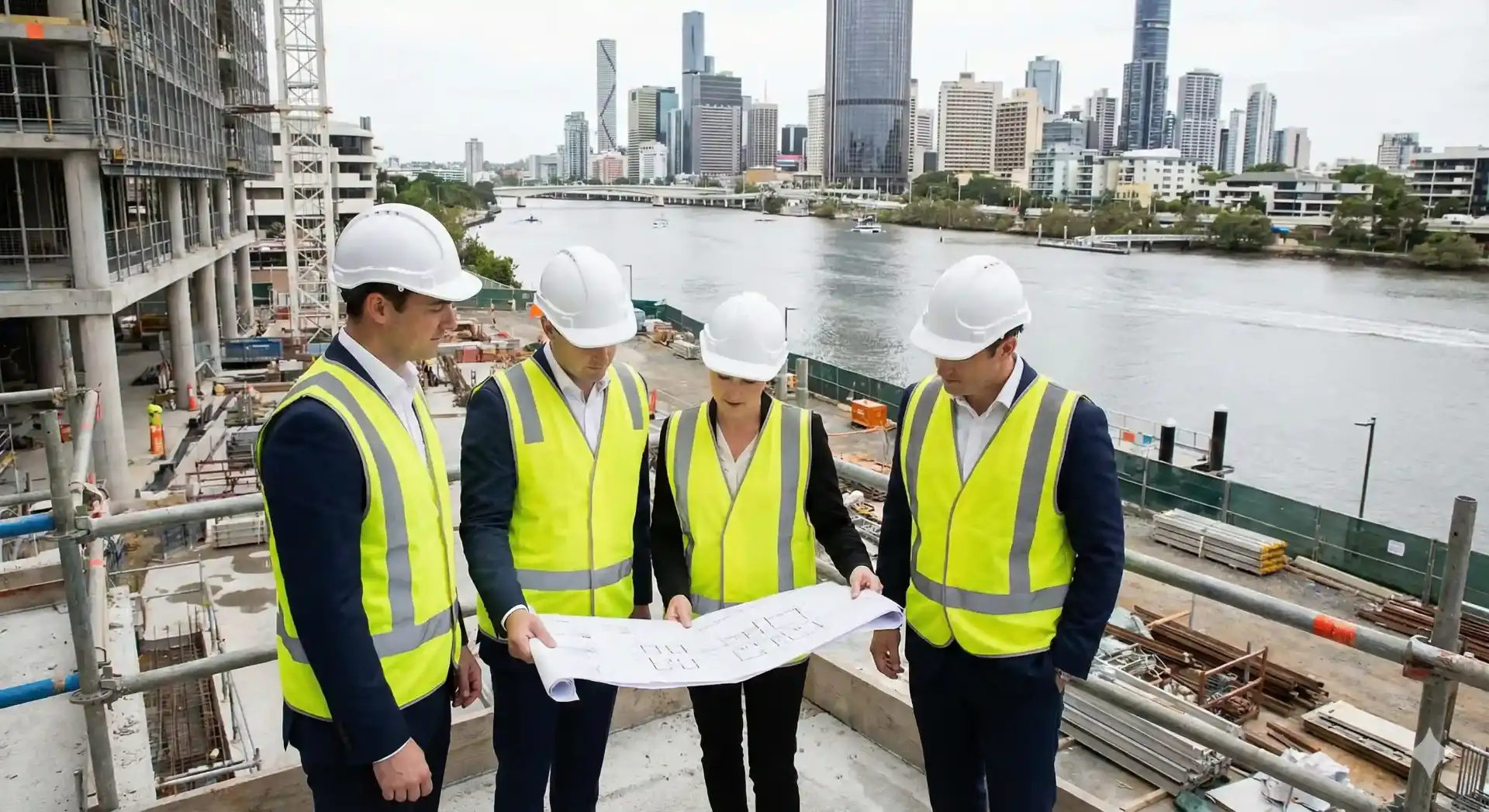
Australian construction projects involve some of the most complex contractual arrangements in commercial law. The contract must allocate risk between the principal, the head contractor and subcontractors across time, cost, quality and scope. When risk allocation provisions are unclear or unfairly skewed, disputes are inevitable. At Astris Law, we advise principals, head contractors and subcontractors on construction contract drafting, risk allocation and dispute resolution.
Dealing with a construction dispute or contract negotiation? We advise on risk allocation, security of payment and dispute resolution. Call +61 7 4270 8880.
Extensions of Time (EOT) Clauses
An extension of time clause entitles the contractor to additional time to complete the works when delay is caused by events outside their control. The most critical drafting issue is whether the contractor must give notice of the delay within a prescribed period and what happens if they fail to do so.
Time bar clauses - provisions that extinguish the contractor's right to an EOT if notice is not given within a strict timeframe - are common in Australian construction contracts. In Probuild Constructions (Aust) Pty Ltd v DDI Group Pty Ltd [2017] NSWCA 151, the NSW Court of Appeal upheld a 5 business day time bar for EOT claims. The contractor's failure to notify within time meant it lost its entitlement entirely, even though the delay was caused by the principal.
The interaction between the EOT clause and the liquidated damages clause is critical. If the contract does not provide for an EOT in circumstances where the principal has caused the delay, the liquidated damages clause may be unenforceable and time may be set "at large" - meaning the contractor need only complete within a reasonable time. The leading authority is Peninsula Balmain Pty Ltd v Abigroup Contractors Pty Ltd [2002] NSWCA 211.
Liquidated Damages
Liquidated damages clauses specify a pre-agreed amount payable by the contractor for each day or week of delay beyond the date for practical completion. To be enforceable, the amount must be a genuine pre-estimate of the loss the principal would suffer from delay, not a penalty.
The High Court's decision in Andrews v Australia and New Zealand Banking Group Ltd [2012] HCA 30 and subsequently Paciocco v Australia and New Zealand Banking Group Ltd [2016] HCA 28 clarified the penalty doctrine. A clause is penal if it is "out of all proportion" to any legitimate interest of the innocent party. In construction, this means the daily rate must bear some reasonable relationship to the principal's actual losses from delayed completion.
Variations
Construction projects almost always involve changes to the original scope. Variations clauses govern how changes are instructed, valued and paid. Common disputes arise where:
- Work is performed without a formal variation instruction and the contractor claims it was a directed variation
- The parties disagree on the valuation methodology for a variation
- The principal argues that work falls within the original scope (not a variation) while the contractor claims it is additional work
Well-drafted variations clauses require written instructions, a clear valuation methodology (usually rates, cost-plus or lump sum) and a process for resolving disagreements before work proceeds.
Latent Conditions
Latent conditions are physical conditions on or near the site that differ materially from the conditions a competent contractor would have reasonably anticipated based on the information available at tender. Common examples include contaminated soil, unexpected rock or groundwater.
Under AS 4000-1997 (the most widely used standard form head contract in Australia), the contractor is entitled to a variation for latent conditions. However, many bespoke contracts attempt to allocate all site risk to the contractor. Where a contractor assumes site risk without adequate investigation, the consequences can be severe.
Proportionate Liability
Proportionate liability legislation applies in every Australian state and territory. In construction disputes involving claims for economic loss or property damage caused by a failure to take reasonable care, the court can apportion liability among concurrent wrongdoers. This means a principal suing the head contractor may recover only a proportion of its loss if the architect, engineer or subcontractor also contributed to the defect.
Importantly, proportionate liability can be excluded by contract in most jurisdictions. Many construction contracts include clauses that exclude the operation of proportionate liability legislation, restoring joint and several liability. Whether these exclusion clauses are effective depends on the jurisdiction and the specific wording used.
Security of Payment: The Statutory Safety Net
Security of payment legislation operates in every Australian state and territory. It creates a statutory right to progress payments that cannot be contracted out of. The legislation provides a rapid adjudication process for payment disputes, typically resolved within weeks. The leading High Court authority on the validity of adjudication determinations is Probuild Constructions (Aust) Pty Ltd v Shade Systems Pty Ltd [2018] HCA 4, which held that an adjudication determination cannot be challenged for jurisdictional error in an enforcement proceeding - reinforcing the "pay now, argue later" philosophy.
Conclusion
Construction contract risk allocation is not a matter of adopting a standard form and hoping for the best. Every project has unique risk characteristics that need to be reflected in the contract. Extensions of time, liquidated damages, variations, latent conditions and security of payment provisions interact in ways that can produce unexpected results if not properly drafted. Astris Law advises on construction contract drafting and dispute resolution with a focus on getting the risk allocation right before disputes arise.
This article is for general information purposes only and does not constitute legal advice. You should seek professional advice tailored to your specific circumstances before acting on any information in this article. Liability limited by a scheme approved under Professional Standards Legislation.