

What's in a Name? Digital Real Estate and the Value of Digital Naming Rights
Summary
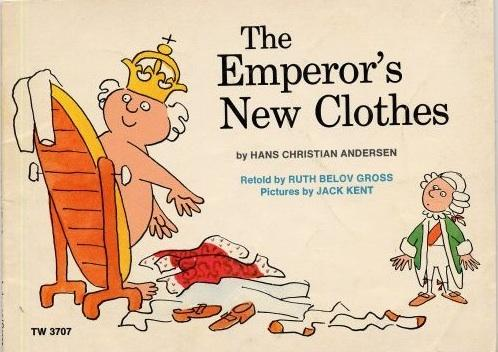
For decades there has been a quiet trend of market competition that few people understand. While Hans Christian Andersen's fable of 'the Emperor Has No Clothes' describes a conspicuous absence that everyone pretends not to see, digital naming rights are about an inconspicuous presence that only savvy players see, while everyone else is none the wiser.
Key Takeaways
- Australia does not recognise a standalone right of publicity; protection of digital naming rights relies on a patchwork of s 18 of the Australian Consumer Law, the tort of passing off and the Trade Marks Act 1995 (Cth).
- Comparison articles and SEO strategies that use a competitor's name may breach the ACL if the overall impression is misleading or deceptive, as established in Google Inc v ACCC (2013) 294 ALR 404.
- Registering a personal or brand name as a trade mark under the Trade Marks Act 1995 (Cth) transforms it from a personal attribute into a proprietary asset, enabling clear-cut infringement claims rather than vague confusion arguments.
- On e-commerce platforms like Amazon, trade mark ownership in each jurisdiction is the key to controlling product listings, and failure to register in every market where you sell risks losing access to your own listings through trade mark squatting.

Image: David Beckham and Victoria Beckham - Joe Maher/BFC/Getty Images
For decades there has been a quiet trend of market competition (and in some cases, colonisation) that few people understand. It is the reverse of the emperor having no clothes. While Hans Christian Andersen's fable of 'the Emperor Has No Clothes' describes a conspicuous absence that everyone pretends not to see, "digital naming rights" are about an inconspicuous presence that only savvy players see, while everyone else is none the wiser. It is a hidden digital layer - invisible to the naked eye but highly effective.
The Scenario
Consider this: a local business called "The Not Real Company" employs "John the Very Great". They add him to their website with a professional photo and a summary of his background. It seems like a win for everyone.
However, let us say "Johnny the Very Great" builds a significant reputation. People know him well and they search for his name often. When they do, what do they see? They see "The Not Real Company". In Google searches and image results there are all sorts of metadata and backlinks behind the scenes pointing directly to the firm.
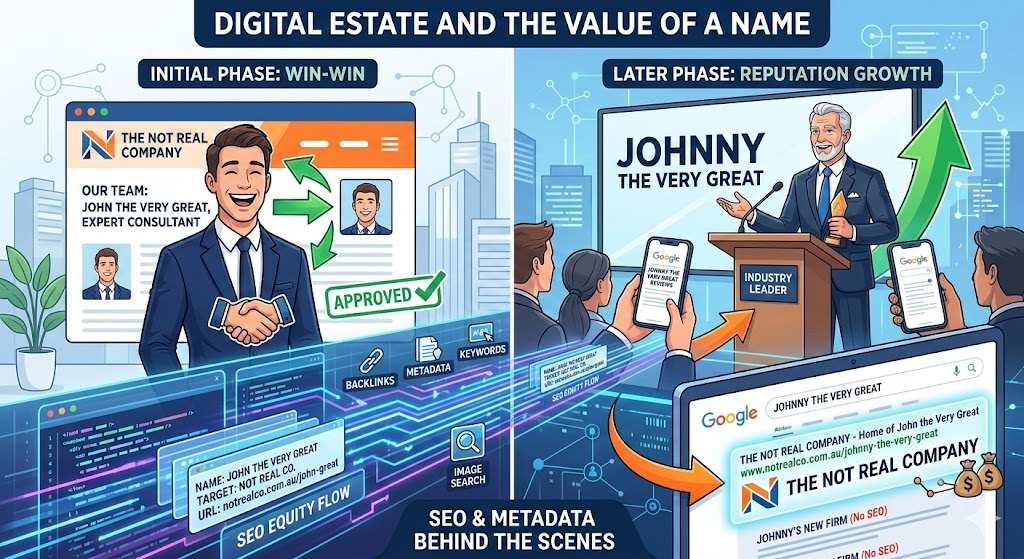
Normally this is all above board until the employee leaves. At that point they might send a polite cease and desist to stop the firm using their name and image. But did they sign a disclaimer in their contract allowing the firm to keep using it? That is where the legal waters get murky.
The Rise of the "Comparison Article"
Where things get aggressive is with "us vs them" digital content. A savvy business might publish an article entitled "Why our firm is better than Competitor X". This is a deliberate attempt to capture the "digital real estate" of a rival. While this is a powerful SEO tool, it also raises legal considerations.
Under Australian law, you can mention a competitor to compare services, but you must be balanced. In GlaxoSmithKline Australia Pty Ltd v Reckitt Benckiser (Australia) Pty Limited (No 2) [2018] FCA 1, the court found that the manufacturer of Nurofen had breached the Australian Consumer Law (ACL) by making false or misleading representations in an advertising campaign comparing the benefits of Nurofen over Panadol. The court reinforced that comparisons must be "like-for-like". If a comparison article omits material facts or skews data to make a competitor look worse, it crosses the line from competitive to deceptive.
The Authority Gap
Unlike the United States, Australia does not recognise a standalone "Right of Publicity". You do not technically "own" the commercial use of your identity as an inherent right. Instead, practitioners must rely on a patchwork of legal pillars.
Section 18 of the ACL prohibits conduct that is "misleading or deceptive". As established in Google Inc v ACCC (2013) 294 ALR 404, the focus is on the "overall impression" given to the consumer. If a firm's SEO strategy leads a client to believe a practitioner is still available at the firm or that there is an official affiliation, they may be in breach.
Alternatively, the Tort of Passing Off may apply. To succeed here, a professional must prove the "Taco Test" (as applied in Taco Bell v Taco Co of Australia (1982) ATPR 40-303): that they have a reputation, that the firm made a misrepresentation and that this caused damage to their goodwill.
As seen in Veda Advantage Ltd v Malouf Group Enterprises (2016) 334 ALR 84, while using a competitor's name in "invisible" keywords is often permissible, using it in visible headings (like a comparison article title) can cross the line if it suggests an official connection or misleads the searcher before they even click.
The Beckham Strategy
David and Victoria Beckham are one example of treating a family name as digital real estate. Their strategy went far beyond standard celebrity vanity; it was a comprehensive land grab of the commercial landscape.
The Beckhams trademarked not only their own names but also those of their children (Brooklyn, Romeo, Cruz and Harper). In doing this, the Beckhams ensured that the family brand was "future-proofed" before the kids were even old enough to have careers of their own. This preemptive move ensured that no third party could register domains or social handles using the children's names, any future business ventures (from photography to fashion) were legally cleared and protected from day one and that in a search-driven economy, they could maintain a monopoly on the "Beckham" keyword across generations.
The Beckhams didn't just manage fame; they treated their family tree as a diversified portfolio. They recognised early on that in the digital age, whoever controls the name controls the traffic. And whoever controls the traffic controls the revenue.
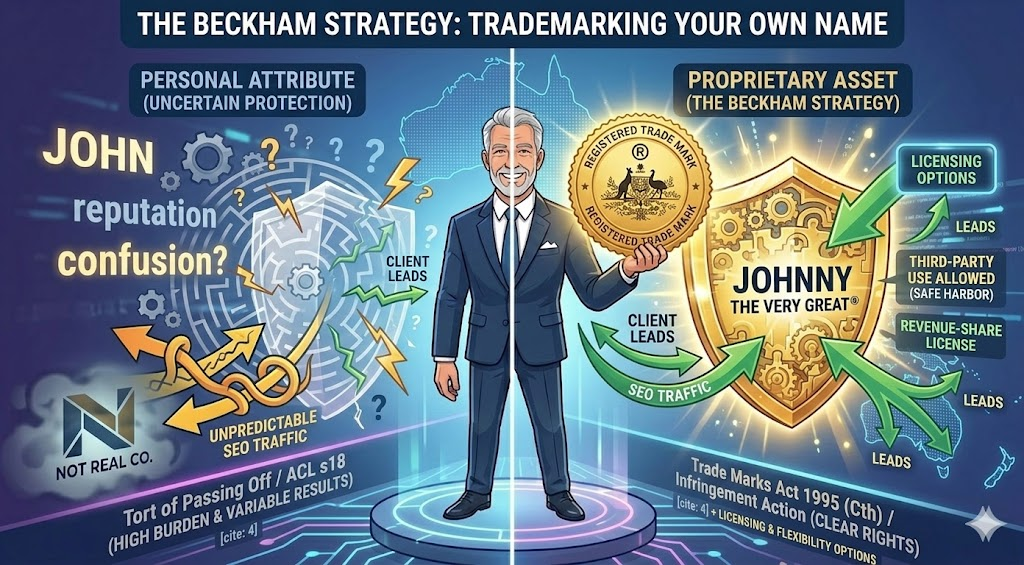
While it may seem perverse to trademark your own name, by registering a name as a trade mark under the Trade Marks Act 1995 (Cth), you could, in theory, transform your name from a personal attribute into a proprietary asset, potentially reframing disputes from vague arguments about "confusion" into clear-cut cases of intellectual property infringement.
The E-Commerce Turf War
The stakes become even more tangible in e-commerce. On platforms like Amazon, trade mark ownership is not just a branding exercise - it is the key to the listing itself. Amazon operates a Brand Registry that ties product listings to registered trade marks in each jurisdiction. If a competitor registers your brand name as a trade mark in a market where you have not yet filed, they can use that registration to have your products delisted entirely.
Amazon will typically follow the local trade mark register. If someone holds the registered mark in that jurisdiction, they can file a complaint and Amazon will remove the competing listings - regardless of who created the brand, who built the customer base or who was selling first. The original brand owner may find their own products taken down in favour of a third party who simply filed the paperwork first.
This is not a hypothetical. It is a well-known tactic in cross-border e-commerce, sometimes called "trade mark squatting". A party registers a mark in a jurisdiction where the original owner has not yet sought protection, then leverages that registration to control the marketplace. The result is a literal turf war fought not over physical territory but over naming rights in each country's trade mark register.
For Australian businesses selling internationally, the lesson is clear: if you are selling on Amazon, eBay or any platform that enforces trade mark-based brand protection, you need to register your marks in every jurisdiction where you sell - or risk losing access to your own product listings.
Make no mistake about it: digital real estate has real value. The ones who understand the intersection of SEO and intellectual property are the ones who come out ahead.
This article is for general information purposes only and does not constitute legal advice. You should seek professional advice tailored to your specific circumstances before acting on any information in this article. Liability limited by a scheme approved under Professional Standards Legislation.