

Rule 208C and 208D UCPR - Supreme Court vs Inferior Courts
Summary
Can r 208C and r 208D UCPR applications be filed in the Magistrates Court or District Court in Queensland?
Key Takeaways
- Since 1 May 2024, applications for preliminary disclosure under r 208C and r 208D UCPR can be filed in the District Court and Magistrates Court, not just the Supreme Court, following the repeal of r 208A by the Uniform Civil Procedure (Fees) and Other Legislation Amendment Regulation 2024 (Qld).
- The Explanatory Note to the amending regulation confirms the legislature's intent to extend preliminary disclosure jurisdiction to all three Queensland courts to which the UCPR applies.
- In Allianz Australia Insurance Ltd v ANZ [2025] QMC 24, the Magistrates Court granted an application under r 208C, providing the first known inferior court authority on the Part 1 preliminary disclosure regime.
- Filing in the Magistrates Court offers lower filing fees, simpler procedures and more proportionate outcomes for disputes within its monetary limits.

Since 1 May 2024, applications for preliminary disclosure under r 208C and r 208D of the UCPR can be filed in the District Court and the Magistrates Court - not just the Supreme Court. Despite this, a widespread misconception persists that these applications remain exclusive to the Supreme Court.
Need preliminary disclosure before commencing proceedings? We handle pre-action applications under r 208C and r 208D across Queensland courts. Call +61 7 4270 8880.
The source of the confusion is straightforward, and the legislative record is clear.
The original restriction
When Chapter 7, Part 1 of the UCPR introduced the preliminary disclosure regime in 2021, r 208A confined it to the Supreme Court. At the time, that restriction was accurate - and several published commentaries said as much. Until recently, the only reported decisions on preliminary disclosure all came out of the Supreme Court (eg., Fairman v Jonelca Holdings Pty Ltd [2025] QSC 40 and Blue Dog Group Pty Ltd v Glaucus Research Group California LLC [2024] QSC 37).
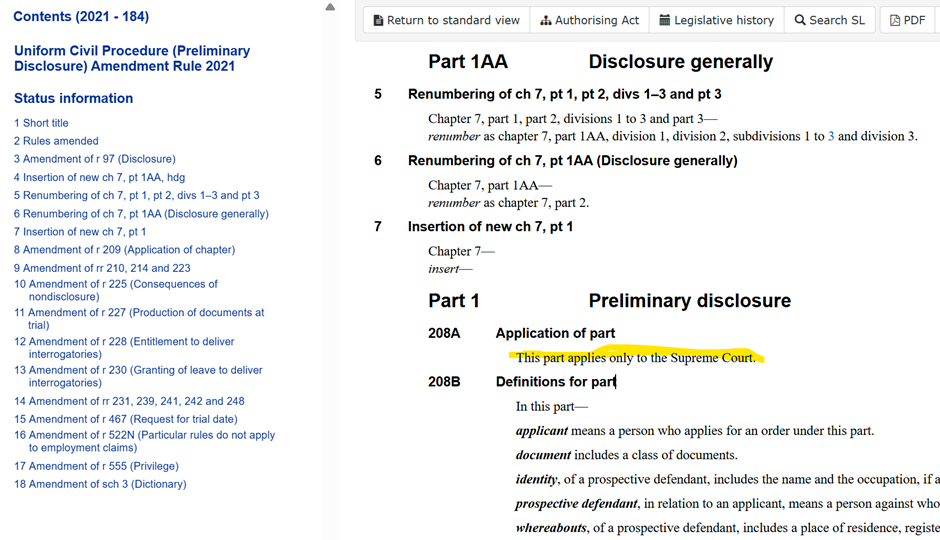
Those commentaries and case results cemented a firm assumption: all roads lead to the Supreme Court.
The 2024 repeal
On 1 May 2024, r 208A was repealed by the Uniform Civil Procedure (Fees) and Other Legislation Amendment Regulation 2024, 2024 SL No. 4 s 22.

The Explanatory Note to the amending legislation states the purpose of the repeal:
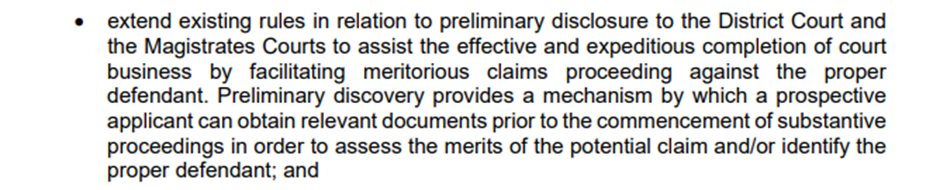
The intent is clear. The legislature removed the Supreme Court restriction so that preliminary disclosure could be sought in the District Court and the Magistrates Court as well. The UCPR applies only to these three courts.
Practical implications
Filing in the wrong court risks a transfer order with costs. Where the underlying dispute falls within the Magistrates Court's monetary limits, there is now a clear basis to file there. The process is simpler, filing fees are lower and the outcome is more proportionate to the value of the claim.
2026 Update: Magistrates Court considers Part 1
Since this article was first published in 2025, the Magistrates Court has considered the preliminary disclosure regime under Chapter 7, Part 1. In Allianz Australia Insurance Ltd v Australia and New Zealand Banking Group Ltd [2025] QMC 24, Magistrate Pinder granted an application under r 208C for preliminary disclosure in the Brisbane Magistrates Court. While this decision concerned r 208C specifically (not r 208D), both rules sit within the same Part, and the jurisdictional analysis applies equally to both.
The case involved an insurer that had paid $44,502.14 to its insured by bank transfer, but the funds were accidentally deposited into the wrong account. The insurer sought orders requiring ANZ to produce documents identifying the account holder so it could pursue a claim for unjust enrichment against the unknown recipient.
Critically, the Magistrate observed at [10]–[11] that while the provisions of Chapter 7, Part 1 initially only applied to the Supreme Court, the repeal of r 208A effective 16 February 2024 meant that the District Court and Magistrates Court are now vested with the power to make orders for preliminary disclosure. The Magistrate noted this was "one of the first, if not the first, applications for preliminary disclosure in the Magistrates Court."
This is the only known inferior court decision to date considering the Part 1 preliminary disclosure regime, and it provides practitioners with a reported authority to cite when filing applications under r 208C or r 208D in the lower courts.
Conclusion
The repeal of r 208A and its Explanatory Note confirm that preliminary disclosure under r 208C and r 208D is no longer confined to the Supreme Court. Parties in Queensland may file in the Magistrates Court or the District Court, subject to the usual jurisdictional rules. The decision in Allianz v ANZ [2025] QMC 24 now provides a direct Magistrates Court example of this.
This article is for general information purposes only and does not constitute legal advice. You should seek professional advice tailored to your specific circumstances before acting on any information in this article. Liability limited by a scheme approved under Professional Standards Legislation.